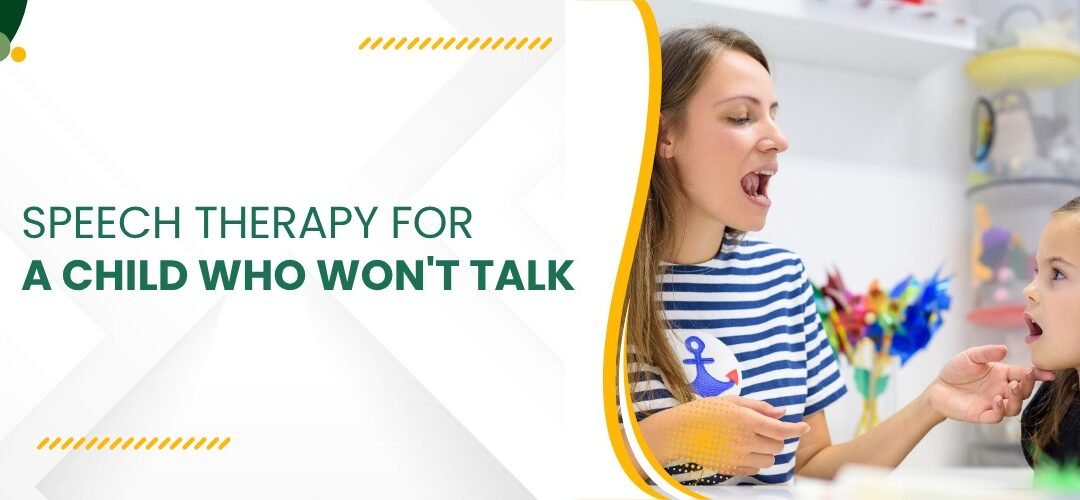
Speech therapy directly addresses the neurological, motor, and behavioural barriers that stop a child from speaking. A child who doesn’t talk isn’t simply “late” there’s usually a specific reason: delayed language processing, oral motor weakness, sensory sensitivities, or conditions like autism or verbal apraxia. Therapists identify the root cause first, then build a structured pathway from pre-verbal communication to functional speech. That sequence matters. Skipping it is why many children plateau elsewhere.
According to Dr. Purva Pande, a specialist in Speech Therapy for Children in Gurugram, “children who don’t speak at all often have preserved comprehension the goal is to build an output channel that matches what’s already developing internally.”
Is your child showing understanding but still not speaking?
What Does a Speech Therapist Actually Do With a Non-Verbal Child?
Therapy with a non-verbal child isn’t about drilling words. It starts with whatever the child already does and works outward from there.
- Baseline reading: The therapist first maps what the child already communicates, whether through eye contact, gestures, sounds, or facial expressions, because that becomes the starting point rather than zero.
- AAC tools: For children who aren’t yet producing sounds, augmentative and alternative communication devices or picture boards give them a functional voice before verbal speech catches up and don’t delay speech development; they support it.
- Oral motor work: Some children genuinely can’t coordinate the tongue, lips, and breath needed for words, so exercises target those specific muscle groups rather than language in the abstract.
- Social turn-taking: Conversation is a two-way act, and therapists use structured play to build the back-and-forth rhythm a child needs before any actual words are added.
Early speech therapy isn’t about age-appropriate milestones in isolation; it’s about closing the gap between what a child understands and what they can express, which is exactly what speech delay therapy targets at its core.
When Should You Start Speech Therapy for a Non-Verbal Child?
Most parents wait too long. The neural plasticity window in early childhood doesn’t stay open indefinitely.
- Red flags at 12 months: A child not babbling, not pointing, and not responding to their name by twelve months warrants a developmental assessment rather than a wait-and-watch approach from any paediatrician.
- The 18-month rule: No single recognisable word by 18 months is a clinical threshold, not a grey area, and intervention started before 24 months consistently produces better outcomes than the same therapy started at age three or four.
- Diagnosis doesn’t have to come first: Parents often delay therapy because they’re still waiting on an autism or developmental diagnosis, but speech therapy doesn’t require one it starts on presenting symptoms.
- Parent role: Therapists coach parents to carry techniques into daily routines because a child’s communication environment for 23 hours outside the clinic either accelerates or undermines the one hour inside it.
The earlier the referral, the shorter the overall course of therapy tends to be, and if you’re wondering where to start, speech therapy for late talkers breaks this down further. That’s not a coincidence.
Why Choose Dr. Purva Pande?
Dr. Purva Pande, Founder and Director of Milestones Child Development Center, established the clinic in 2022 with a multidisciplinary team holding over 20 years of combined experience across Artemis, Medanta, and CK Birla Hospital. The centre is the first in Delhi NCR to offer DMI therapy and Dynamic Flex Cast, and its speech therapy programme integrates occupational and sensory approaches where needed rather than treating communication in isolation.
Children who didn’t progress for months at other clinics have shown measurable change within three months here. The therapy is structured, the goals are clinical rather than generic, and parents are trained as active participants
Frequently Asked Questions
Can a child start speech therapy without a formal diagnosis?
Yes, therapy starts based on observed communication delays without a diagnosis required.
At what age is speech therapy most effective?
Earlier is better; starting before age three produces consistently stronger outcomes.
Will using a communication device stop my child from learning to speak?
No, AAC devices support speech development and don’t replace verbal communication goals.
How long does it take to see results from speech therapy?
Most families notice measurable changes within eight to twelve weeks of consistent sessions.
Reference links:
- NIH National Institute on Deafness and Other Communication Disorders
- Kwok et al. (2020), International Journal of Speech-Language Pathology Effectiveness of a parent-implemented language intervention for late-talking children
Disclaimer: The information shared in this content is for educational purposes and not for promotional use.
