

If your child struggles to sit still, focus on tasks, follow instructions, or manage emotions, you’re not alone. Many parents notice these challenges but aren’t sure whether it’s a phase or something more. With the right ADHD therapy in Gurgaon, at Milestones CDC, children can develop better focus, behaviour control, and confidence in daily life.
We provide structured and personalised ADHD treatment for children in Gurgaon, led by Dr. Purva Pande and a multidisciplinary team. From assessment to therapy, every step is designed to help your child improve attention, behaviour, and participation at home and school.
“Motor delay is rarely just about weak muscles. It’s about how the brain and body learn to work together. When we catch the cause early, whether it’s low tone, a coordination problem, or a neurological condition, we can retrain movement while a child’s brain is still very open to change. The sooner we start, the more we can do,” says Dr. Purva Pande, Pediatric Physiotherapist, Child Development Centre in Gurugram.
What Motor Delay Actually Means
Motor delay occurs when a child reaches movement milestones later than expected. It may affect gross motor skills such as sitting, crawling, standing, and walking, or fine motor skills such as grasping objects, using a spoon, and writing.
A delay in one skill may not be a concern. However, professional assessment is advised if several skills are delayed, progress is limited, or previously learned skills are lost.
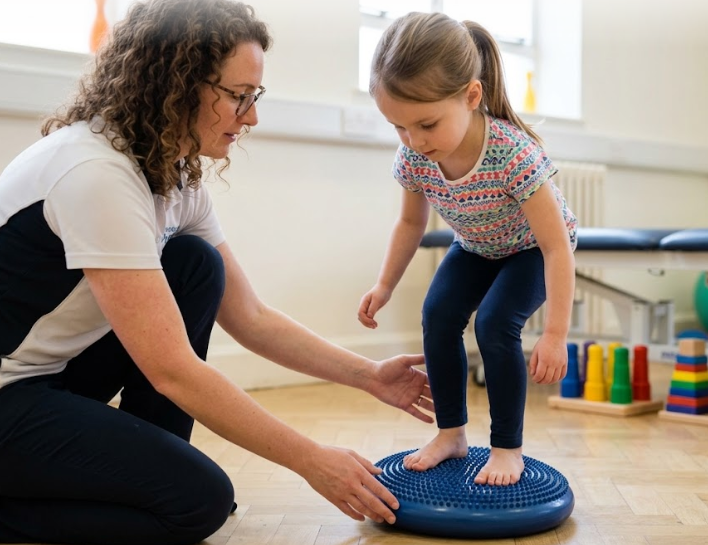
Early Signs of Motor Delay in Children
Every child grows at their own pace, so a little variation is normal. Still, some patterns are worth acting on:
Not holding the head steady for 4 months
Not sitting without support by 9 months
Not crawling or moving to explore by 12 months
Not walking on their own by 18 months
Limbs that feel stiff or unusually floppy
Strongly favouring one hand before age 1
Trouble grasping objects or bringing both hands together
Falling or bumping into things well past the wobbly toddler stage
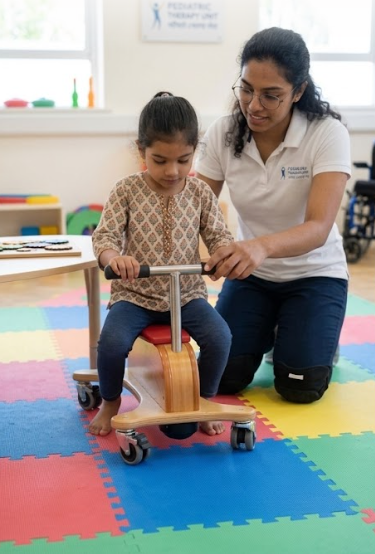
If your child misses two or more of these or their muscles feel too tight or too loose, book an evaluation. Getting it checked rarely does harm, and often brings relief.
What Causes Motor Delay?
Motor delay isn’t a diagnosis by itself. It’s a sign that something needs a closer look. The reasons vary a lot:
Cerebral palsy, which affects muscle tone and coordination
Low muscle tone, where muscles feel floppy, and sitting or standing is harder
Premature birth, since early babies often need extra time to catch up
Genetic conditions such as Down syndrome or muscular dystrophy
Coordination difficulties, where planning and carrying out a movement is tricky
Brain injury or infection around the time of birth
Vision or sensory issues that make a child less keen to move and explore
No clear cause, where a child simply needs a bit of help to catch up
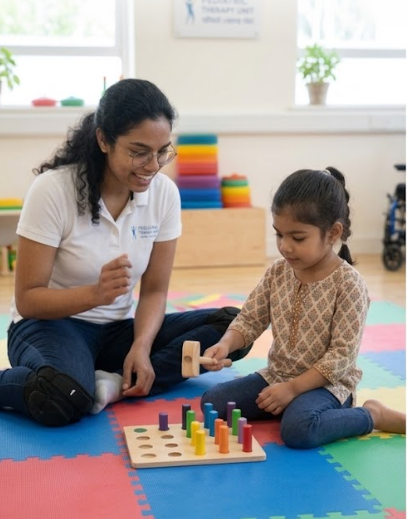
Finding the reason shapes the whole plan. That’s why a proper assessment always comes first.
How We Assess Motor Delay
Diagnosis isn’t one single test. At Milestones CDC, it usually looks like this:
A detailed history covering pregnancy, birth, and your child's milestones so far
A physical check of muscle tone, reflexes, posture, and how the joints move
Standard assessment tools that compare your child's skills against age norms
Watching how your child moves, plays, and reacts during the session
A referral for further testing if we suspect an underlying condition
The point isn’t just to hand you a label. It’s to get a clear picture of what your child can do, where they’re stuck, and what to work on first.
Motor Delay Therapies We Offer
There’s no one-size-fits-all fix. The right approach depends on the child. Here’s how our main therapies compare:
| Therapy | Best For | What It Does |
| Pediatric Physiotherapy | Gross motor delays, weakness | Builds strength, balance, and mobility through play |
| Neuro-Developmental Therapy | Cerebral palsy, tone problems | Uses hands-on guidance to shape better movement patterns |
| Occupational Therapy | Fine motor and daily skills | Improves grasp, coordination, and everyday independence |
| TASES Therapy | Muscle activation | Gentle stimulation during real movements to retrain muscles |
| Dynamic Flex Cast | Toe-walking, tight muscles | Flexible casting that supports alignment while allowing movement |
Most children do best with a mix. Our therapists talk to each other constantly, so progress in one area feeds into another.
Why Early Motor Delay Treatment Matters
A young child’s brain adapts fast, especially in the first few years. Early therapy works with that natural flexibility instead of against it.
Getting started sooner can help a child build strength and balance, reach milestones closer to schedule, and avoid knock-on problems like stiff joints or poor posture. It also does something quieter but just as important: it builds confidence. A child who can keep up with playmates feels it.
Waiting rarely pays off. Even when a delay is mild, structured support gives a child a stronger foundation.
Why Parents Choose Milestones CDC
Families across Gurgaon and Delhi NCR come to us because we pair real clinical experience with genuine warmth.
A team of pediatric physiotherapists, occupational therapists, and speech specialists with years of combined experience
Led by Dr. Purva Pande, with over 14 years in child development
Among the first in Delhi NCR to offer techniques like Dynamic Flex Castand TASES
A separate plan for every child, never a template
Parents are treated as part of the team, with exercises to use at home
Regular progress checks, so you always know how therapy is going
Early assessment can help identify the cause and guide the right plan, including physiotherapy, neuro-developmental therapy, occupational therapy, TASES, or Dynamic Flex Cast.
At Milestones Child Development Center in Gurgaon, we help children move, grow, and develop with the right early support.
Frequently Asked Questions
At what age should I worry about motor delay?
Can a child outgrow a motor delay?
Is motor delay the same as cerebral palsy?
How long does therapy take to show results?
Can I help my child at home?
References
- World Health Organization — Developmental difficulties in early childhood: https://www.who.int
- Centers for Disease Control and Prevention (CDC) — Developmental Milestones: https://www.cdc.gov/ncbddd/actearly/milestones/index.html
- National Institutes of Health (NICHD) — Motor and Developmental Delays: https://www.nichd.nih.gov