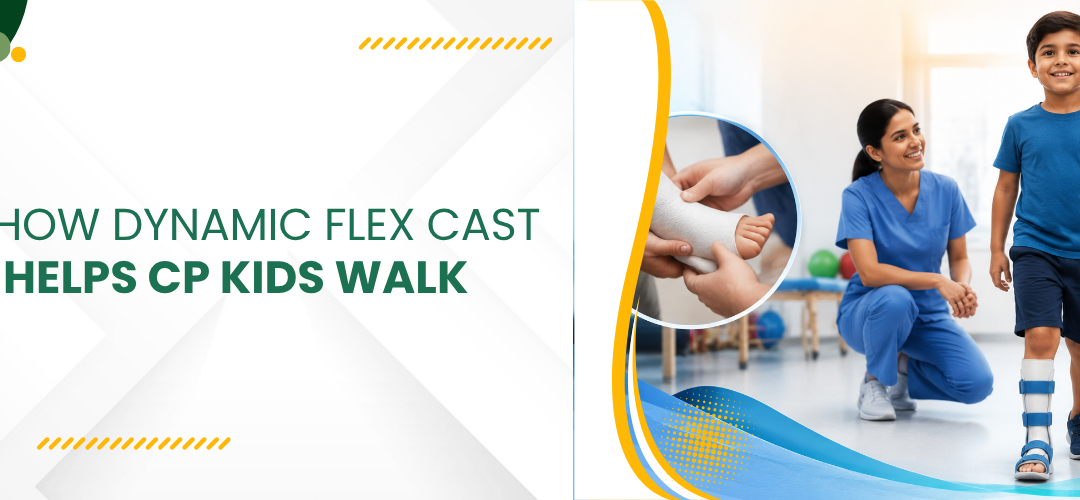
Dynamic Flex Cast improves walking in children with cerebral palsy by using soft, semi-flexible casts that gently align the feet and ankles, reduce spasticity, and promote active movement. Unlike rigid plaster casting, it allows continuous muscle engagement, building flexibility and strength while supporting a proper heel-to-toe gait pattern.
Kids wear the cast through normal play, standing, and walking. That’s the whole point. The correction happens while the child is moving, not while they sit still in a hard cast for six weeks.
According to Dr. Purva Pande, Dynamic Flex Cast, Most spastic CP children don’t need rigid immobilization, they need controlled correction during real movement, and that’s exactly what dynamic casting gives us in the clinic.
Is your child still toe-walking despite months of physiotherapy?
How does Dynamic Flex Cast actually correct gait in cerebral palsy?
It works by giving the calf a slow, steady stretch while the child keeps moving. So the muscle relaxes, the ankle sits in a better position, and the child practices walking on that better position every single day.
- Spasticity: A low-grade stretch on the gastroc and soleus calms down the over-firing reflex that keeps those muscles tight in the first place.
- Heel strike: Toe walkers physically can’t push past the cast’s stop angle, so the foot has to land flat or heel-first. The brain figures it out fast.
- Joint stack: Once the foot stops rolling in, the knee and hip stop compensating. You can see the alignment change above the ankle within a few weeks.
- Movement carries over: Crawling, kneeling, standing, walking — all of it happens in the cast. That’s why the gains hold once it comes off.
Older serial casting locked the leg and waited. This doesn’t. We pair it with pediatric physiotherapy so the child is actively training the new pattern, not just wearing a brace.
Which CP children benefit most from Dynamic Flex Cast?
Not every child. The kids who respond fastest tend to share a similar profile, and a 20-minute clinical look usually tells us if it’s the right call.
- Spastic diplegia: Bilateral calf tightness and a crouch gait. These children often respond fastest because the cast goes straight at the muscle that’s pulling them into the crouch.
- Hemiplegic CP: One leg drags or swings out. Stride evens out once the affected ankle isn’t fighting dorsiflexion anymore, and parents tend to spot the change before we point it out.
- Persistent toe walkers: Whether the cause is neurogenic or idiopathic, casting helps. Combined with neurodevelopmental therapy, the postural retraining sticks better.
- After Botox: Botox lengthens the calf for a window of time. Casting in that window locks in the longer position so the gain doesn’t disappear when the Botox wears off.
For a fuller read on how motor control therapy works alongside casting, the neurodevelopmental therapy benefits post covers it well.
Why Choose Dr. Purva Pande?
Dr. Purva Pande is a pediatric physiotherapist with over 15 years in cerebral palsy rehab. She’s certified in Dynamic Flex Cast, DMI, and NDT, and runs one of the first centers in Delhi NCR offering this casting protocol. More about her practice at Dr. Purva Pande.
What parents notice most is the speed. Children often gain more in three months here than in a full year elsewhere. We measure heel strike, standing tolerance, and independent walking distance at every review, so progress isn’t a feeling, it’s on paper.
Frequently Asked Questions
How long does my child need to wear the Dynamic Flex Cast?
Most protocols run 4 to 8 weeks with cast changes every 1 to 2 weeks based on response.
Can my child walk and play wearing the cast?
Yes, the cast is designed for full active movement including walking, standing, and floor play.
Is Dynamic Flex Cast painful for the child?
The cast is non-invasive and well tolerated, with most children adjusting within the first 24 hours.
At what age can a child start Dynamic Flex Cast therapy?
Children as young as 18 months can begin treatment if gait or ankle issues are clinically significant.
Reference links:
- World Health Organization – Disability and rehabilitation in children
- National Institute of Neurological Disorders and Stroke – Cerebral Palsy Information
Disclaimer: The information shared in this content is for educational purposes and not for promotional use.
