
When a child echoes lines from their favourite movies or repeats your questions instead of answering, it’s natural for parents to wonder if something’s amiss. Echolalia—this habit of repeating words or phrases—might look unusual, but it’s actually a typical stage in language development and can serve real communicative functions, especially for kids with autism or other developmental differences.
Speech therapy helps children transform echolalic speech into spontaneous, purposeful communication by using strategies that view echolalia as a useful stepping stone, not just a hurdle. Today’s therapy methods build on a child’s repeating patterns, gradually opening doors to more original language that lets them share needs, thoughts, and feelings—sometimes in ways you might not expect.
At Milestones Child Development Center, we see echolalia not as a setback but as a stepping stone. Through guided speech therapy, we help children turn repeated words into meaningful, independent communication that reflects their true voice.
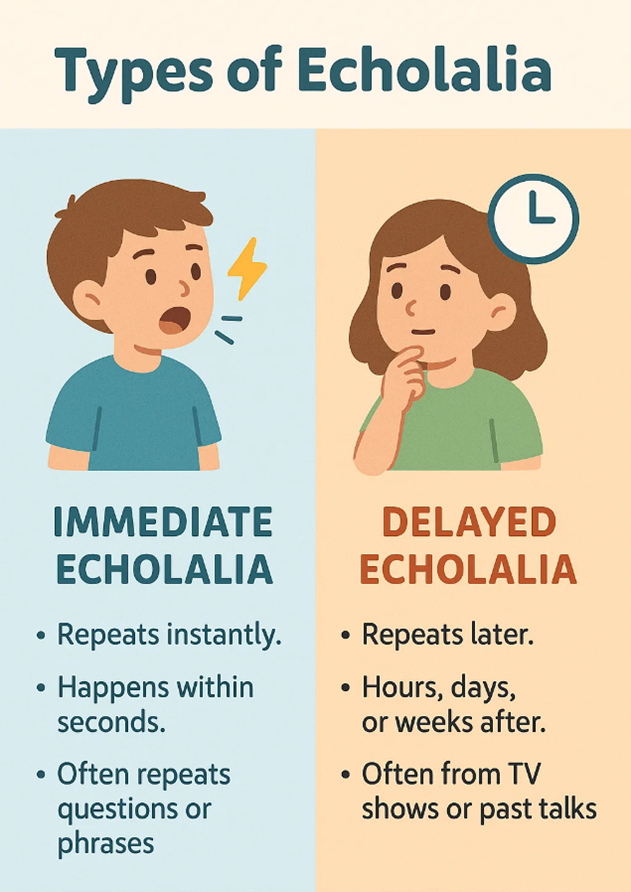
Types of Echolalia
Echolalia shows up in two main forms: immediate and delayed. Spotting the difference helps parents and professionals better understand a child’s unique way of repeating speech.
Immediate Echolalia is when a child repeats words or phrases right after hearing them—sometimes within seconds.
For instance, if you ask “Do you want biscuits?” and the child answers “Do you want biscuits?” instead of giving a yes or no, that’s immediate echolalia in action.
Delayed Echolalia is a bit different; it’s when kids repeat phrases hours, days, or even weeks after first hearing them. You might catch your child reciting lines from TV shows or replaying old conversations at unexpected moments.
This delayed kind is especially common for kids with autism spectrum disorder (ASD).
Each type serves its own purpose. Immediate echolalia can help kids process language or keep a conversation going, while delayed echolalia might offer comfort, fill in communication gaps, or even signal a need in a roundabout way.
How Speech Therapy Helps Children with Echolalia
Speech therapy goes beyond just correcting repetition; it’s about guiding kids to turn those repeated phrases into meaningful, functional communication. Licensed speech-language pathologists work closely with children to help build the foundation for spontaneous speech and practical language.
Some of the main therapy strategies include:
- Language modelling – Therapists show what appropriate responses sound like in real situations
- Expansion techniques – Taking echoed phrases and adding to them, nudging kids toward new meanings
- Visual supports – Using pictures or symbols to make things clearer
- Contextual practice – Teaching when and how to use certain phrases in the right moments
Getting help sooner rather than later really matters for kids who keep echoing. Regular, structured therapy sessions can lead to steady growth in language skills.
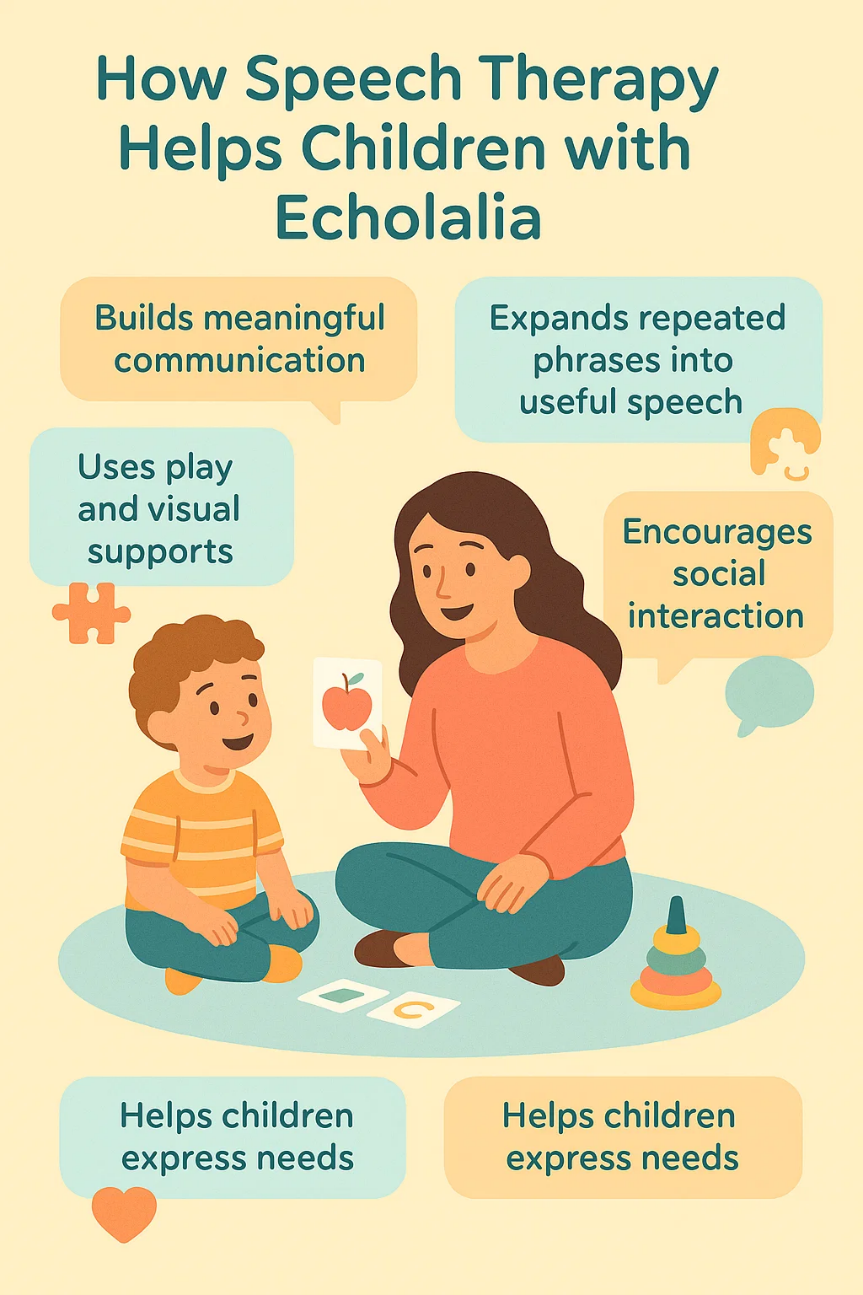
Therapists understand that echolalia often has a real communicative purpose. Instead of simply trying to stamp it out, they focus on broadening a child’s expressive language, always keeping the child’s natural style in mind.
The process is gradual—kids are encouraged to use familiar phrases in more flexible ways, so over time, they gain more independence in communicating.
Benefits of therapy can include:
- Better communication development overall
- Improved social skills
- More flexibility in language use
- More attempts at speaking spontaneously
Therapy Approaches Parents Might See
Speech-language pathologists use a range of proven techniques with kids who have echolalia. Parents will likely notice these in sessions and many are simple enough to try at home.
Functional Communication Training teaches kids to swap out repetitive speech for more meaningful words. For example, instead of echoing “Do you want juice?” the child learns to say “juice, please.” It’s straightforward but surprisingly powerful.
Modelling language is a staple—therapists respond to echoed phrases by showing what a more appropriate answer looks like. They’ll gently expand on what the child says, demonstrating better sentence structure and context. Here’s where functional communication really comes into play.
Visual supports and scripting use tools like picture boards or speech devices to guide kids toward more purposeful speech. Therapists might set up specific scripts for greetings or requests, giving children a clear path to follow in social situations.
Time delay strategies are about giving kids a moment to think. The therapist might say, “Do you want…” and pause, letting the child fill in the blank instead of just repeating the whole phrase.
Play-based therapy weaves speech work into everyday activities. Through games, songs, and social play, children practise new skills in a way that feels natural—not forced. It’s amazing how much learning happens when kids are just having fun. Communication skills often blossom in these relaxed settings.
Many speech therapists also team up with occupational therapists to address sensory issues that sometimes go hand-in-hand with echolalia.
Tips for Parents at Home
There’s a lot parents can do to help, and these communication strategies work best when they’re part of daily life, not just a therapy hour.
Model language by echoing your child’s words and then adding to them. If your child says “Go car,” you might reply, “Yes, let’s go in the car to the shop.” It’s a small shift that can make a big difference.
Visual supports are surprisingly effective. Picture cards and visual routines can help link phrases to real activities and make abstract ideas more concrete.
Try making a daily communication board with images for common activities, feelings, and needs. This encourages functional communication and gives kids more ways to express themselves beyond just repeating.
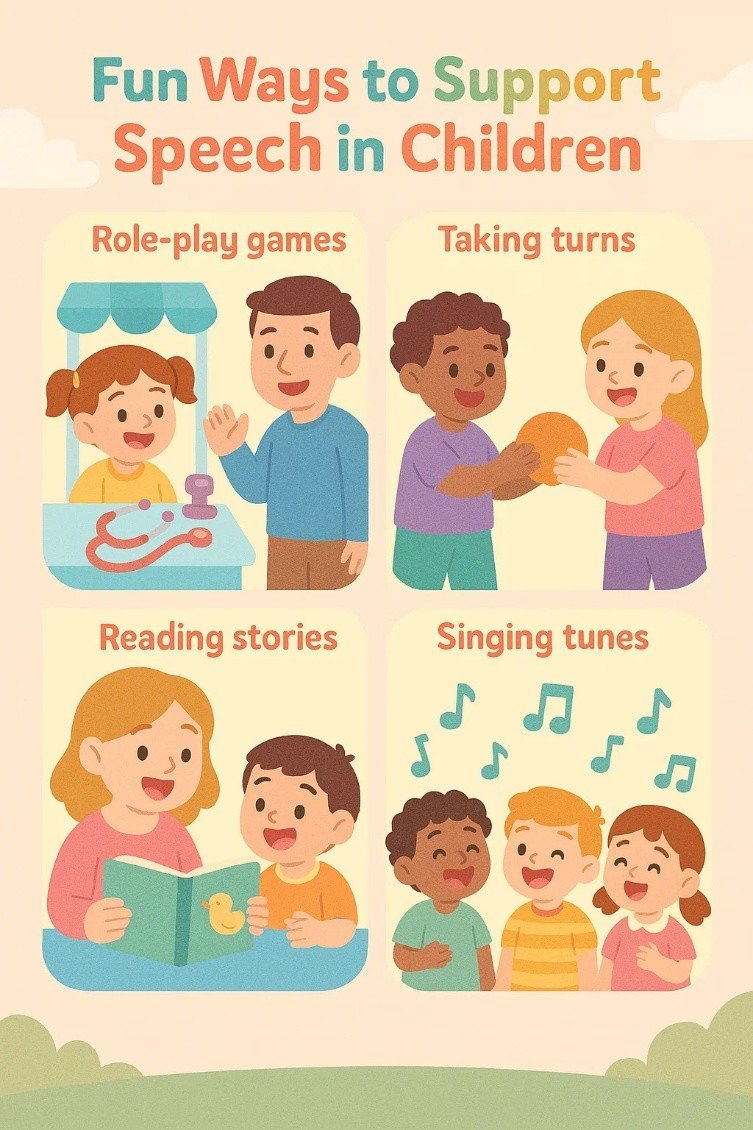
Interactive activities are great for practice:
- Role-play games—think shopkeeper or doctor
- Taking turns in simple activities
- Reading stories together and pausing for your child to chime in
- Singing familiar tunes
Always respond positively, even if your child is still echoing. Every attempt is a step forward, and encouragement builds confidence for more social interaction.
Try making declarative statements instead of firing off questions. Instead of “What do you want?” you could say, “I see you looking at the biscuits,” and wait. Sometimes, the space to respond is all they need.
Emotion charts and other visual aids can also help kids identify feelings and grow self-regulation skills. Point out emotions as they come up throughout the day to model how to use those words.
Stick to routines where language can be practised naturally—mealtimes, getting ready for bed, or any familiar activity. These are perfect chances for practising independent communication with familiar scripts and, over time, new phrases.
When to Seek Professional Help
If echolalia is still a child’s main way of communicating after age 3, it’s probably time to check in with a speech-language pathologist. This could mean your child needs specialised support to learn more flexible language skills.
Some warning signs to watch for:
- Echolalia that gets in the way of socialising or learning
- Loss of words or skills the child had before
- Little eye contact along with the repetitive speech
- Narrow interests plus lots of echoing
Kids with developmental delays might need a broader evaluation. A speech therapist can help figure out whether echolalia is part of autism, a language delay, or something else that needs a specific approach.
Conclusion
Speech therapy is, in many ways, the foundation for helping children move from echolalic speech toward genuine communication. Licensed speech-language pathologists rely on strategies that are carefully matched to each child’s unique needs and stage of development—there’s rarely a one-size-fits-all solution here.
Key therapeutic approaches include:
- Applied Behaviour Analysis (ABA)
• Verbal Behaviour Therapy
• Visual supports and modelling
• Contextual language expansion
Speech therapy recognises echolalia as a meaningful part of language development, not just a repetitive habit. This perspective lets therapists work with existing patterns and gently nudge progress forward.
Family involvement is irreplaceable throughout therapy. Parents and carers pick up practical strategies to help their child communicate more effectively at home and during everyday routines.
Frequently Asked Questions
Q1. Can echolalia show that my child understands language?
Q2. Will echolalia go away on its own?
Q3. Does echolalia mean my child has autism?
Q4. Can echolalia help my child learn conversation skills?
